 It serves absolutely no purpose other than being witty, and for that, I love it.

Tuesday, September 30, 2008
Warhol + graffiti = tomato spray
Also pasted on the wall surrounding the vacant lot next to the gallery was the following poster: It serves absolutely no purpose other than being witty, and for that, I love it.
It serves absolutely no purpose other than being witty, and for that, I love it.

Monday, September 29, 2008
context is everything
 This poster was pasted on the vacant lot next to my gallery. It's rather amusing, of course, but what's even better is exactly *where* it was posted [see after the jump]...
 Heh heh heh. One can only dream, right?
some observations
I ate at a popular bar on the LES last night, which turned out to be an exercise in hipster anthropology.
First: it doesn't matter how attractive you are—if you look like you might barf on me, I'm not interested. Really.* (See below. Suffice it to say that drama comes to me.) See? Still disgusting.
Other observations: beards are IN among the LES/alternative music crowd. Like, on seemingly every other guy I saw last night. Is it because it's getting colder and scarves don't fit into the aesthetic? The price of razors is too high? There has been a spate of contagious eczema?
Finally, don't walk behind wildly gesticulating Eastern European tourists--you never know when one of them might fling a hand backward without looking and stab you in the Adam's apple with a sharpened acrylic fingernail.
* Especially if you do any of the below:
First: it doesn't matter how attractive you are—if you look like you might barf on me, I'm not interested. Really.* (See below. Suffice it to say that drama comes to me.)
 See? Still disgusting.
Other observations: beards are IN among the LES/alternative music crowd. Like, on seemingly every other guy I saw last night. Is it because it's getting colder and scarves don't fit into the aesthetic? The price of razors is too high? There has been a spate of contagious eczema?
Finally, don't walk behind wildly gesticulating Eastern European tourists--you never know when one of them might fling a hand backward without looking and stab you in the Adam's apple with a sharpened acrylic fingernail.
* Especially if you do any of the below:
- You initiate contact by flicking my cuff and smiling at me in a way that suggests you know me. Since you remind me vaguely of my English Ex, I confusedly ask if I know you.
- You don't respond, just grin expectantly, so I roll my eyes and go back to my reading.
- You continue to benignly touch me—caressing my sleeve, poking at my hair in drunkenly gentle manner—even though I am both reading Bakhtin AND ignoring you.
- You continue to do this even after I've asked if I can help you. Really, is there something you want? Some reason you're provoking me?
- You don't answer the above question. In fact, you don't speak at all, leading me to ask, in sign language, if you are deaf.
- After again flicking my jacket cuff (which I am wearing), I say, "Really, WHAT IS IT? What do you want? Because otherwise, QUIT." Loudly. And you grin stupidly. I go back to my reading with renewed vigor.
- The bartender takes pity on me and says, "I think she's busy reading and doesn't want to talk right now." She probably says this because I am about to start screaming at you to
shovefuck off and instigate a barfight if you touch me one. more. time. - After discovering that the bar doesn't accept the card you gave the bartender, you can't figure out how to pay your $88 bar tab. Allow me to repeat: You can't figure out how to pay your $88 bar tab. As in, you try to hand the bartender a $20 bill and ask if that's enough.
- Upon hearing you speak I discover that you're English. You remind me even more of my English Ex. This is not really a good thing.
- A tip: if you hear the following monologue from your bartender that goes anything like:
Sir, we don't take Maestro. Do you have another card?
...you need to go home.
[mumble mumble. Present $20 bill.]
Sir, that's not enough.
[Present $20 bill AGAIN.]
No. [She waits for the penny to drop. It doesn't.]
Do you have a different card?
[Pulls random dollar bills out of pocket.]
Noooo. Do you just have a different card? If you give me a--
[Presents $20 bill. "Thasss not enouf?"]
A different--grrrr. Do you--Do you have a wallet? Give me your wallet.
[You are befuddled by its inexplicable presence in your pocket.]
I'm going to use this card, ok? [She runs card. You put your head on the bar.] You need to sign the receipt, sir. [You don't look up. She mutters: I'm putting my own damn tip on here.] Sign here, sir.
Sir. Sign. Here. THANK YOU. ... ... Sir? Sir, you can't sleep on the bar. - What's that, you say? You don't have a place to stay for the night? You were trying to find someone to go home with at the bar? Jerk.
Sunday, September 28, 2008

Saturday, September 27, 2008
baby-jumping: kind of like Evil Knievel, only without the motorcycle
In the Spanish town of Castrillo de Murcia, there is a yearly festival where men run out of a church dressed in their finest bright yellow jumpsuits to leap over mattresses of babies. Do they ever get kneed in the face, I wonder?
 Look at that one in the little red jumper, she's all like, "Wow." It reminds me of the reactions my cats give me when I'm doing something particularly foreign to feline behavior.
...Also, is it really any wonder why I want to move back to Europe?
 Do they ever get kneed in the face, I wonder?
 Look at that one in the little red jumper, she's all like, "Wow." It reminds me of the reactions my cats give me when I'm doing something particularly foreign to feline behavior.
...Also, is it really any wonder why I want to move back to Europe?
temporary blog weirdness
...I'm trying to figure out a way to post summaries of my longer posts so that the gentle folks who don't want to read 3000 words about Louise Bourgeois don't have to, so there may be some oddness going on here for the next hour.
EDIT: Success! It took some finagling with Javascript and CSS, but we're all set now with the expandable post summaries.
EDIT: Success! It took some finagling with Javascript and CSS, but we're all set now with the expandable post summaries.
Thursday, September 25, 2008
Robert Rauschenberg makes my brain hurt

Robert Rauschenberg, Erased de Kooning Drawing, 1953; traces of ink and crayon; Collection SFMOMA, purchased through a gift of Phyllis Wattis; © Robert Rauschenberg / Licensed by VAGA, New York
I'm not entirely sure if I actively dislike Robert Rauschenberg's work or not because I can't get past phrases like, "...the transformation of the de Kooning into what Rauschenberg called a 'monochrome no-image' can be understood from a Bergonsonian perspective as the evacuation of intentional imagery and individual expression (i.e., 'art') in favor of a receptivity to contingent visual sensations (i.e., 'life')."*
Ow.
Video that helps explain the above drawing:
In other news, I'm in love with this song.
*from Brandon Joseph, "White on White," in Random Order: Robert Rasuchenberg and the Neo-Avantgarde (MIT, 2007), p. 63.
Louise Bourgeois at the Guggenheim
WARNING! Long-winded exhibition review dead ahead...
 At the Louise Bourgeois retrospective at the Solomon R. Guggenheim Collection, we are greeted at the entrance by a large metal spider and what look to be two victims suspended in shiny bright cocoons from above. As Nancy Spector, the curator of the exhibition and the Guggenheim’s chief curator, acknowledges in the introductory text, the spiral of Frank Lloyd Wright’s Guggenheim at 88th Street is a uniquely fitting venue in which to present a retrospective of this ever-avant-garde artist who has returned to themes and motifs throughout her career. Bourgeois’ work functions in a world of unstable, opposing binaries: open/closed, young/old, gravity/attenuation, benign/threatening, human/building, soft/hard, spiral/linear. Works cluster along the walls in chronological groupings; the architectural scale (and color) of the winding path at the Guggenheim lends itself felicitously to the presentation of these objects, and the narrowness of the presentation space focuses the attention by permitting only a few works in the viewer’s field of vision at any one time. Though the spiral ramp forces a linear narrative, its great benefit is its ability to disrupt this strict chronology: by merely peering across the vertigo-inducing open center, the visitor sees works that came before and glimpses of what will follow. In fact, it is largely by virtue of Lloyd Wright’s whorl of an exhibition space that the show coheres—one might almost hope that all retrospectives be shown here, for nowhere else is there the ability to experience both a linear (that is to say, chronological) progression as well as a cross-section of an artist’s oeuvre.
 After the opening salvo of the spider and a brief introduction to her paintings, we are launched into Bourgeois’ career in 1940s New York while married to art historian Robert Goldwater—a more propitious time and place (and husband) is hard to imagine. It was during this time in the late 1940s and early 50s that Bourgeois created the sculptural series known as “Personages,” (left) whose totemesque, vaguely anthropomorphic wood and metal forms, notably “Portrait of C.V.” (1947-49; wood, paint, metal wire), “Persistent Antagonism” (1946-48; wood, paint, metal wire), “The Winged Figure” (1948; wood, paint, nails), and “Sleeping Figure” (1950, bronze), have their relatives in the sculptural art of central equatorial Africa (as the exhibition “Eternal Ancestors: Art of the Central African Reliquary” at the Metropolitan Museum so effectively demonstrated last winter). The slightly later wooden stacked sculptures, whose attenuation recalls Giacommetti’s emaciated figures, often present an escarpment near or at the top, frustrating the ascension to the topmost level and recalling Bourgeois’ quote that “Skyscrapers reflect the human condition. They do not touch.”
 After a decade of absence, Bourgeois emerged in the 1960s to create an odd topsy-turvy world where phallic buds derive from clouds and breasts emerge from the earth to become “cumuls.” Extraordinarily adept at segmenting and de-humanizing the human body, she others it, rendering it insectlike and, by so doing, reinforcing its messy actuality and the earthy humor of human existence. Biomorphic forms (like “Lair,” 1962), which occupy one section look nothing so much as sculpted excremental blobs, have something of the honeycomb—or, in the case of “Fee Couturiere” (1963), the wasps’ nest—about them. Who—or what—lives in these funny little dwellings? What is hidden inside?
 Though the uncircumcised penile tips—or are they preternaturally perky breast buds? Or are they fingertips?—poking their heads hopefully through drapery in “Cumul I” (1969; above) is enough to horrify one’s conservative relatives (one dare not say grandmother in this context), Bourgeois has a mastery of texture and form that renders these things all rather beautiful. Beautiful in the way that earthworms, or giving birth, or the relief of a long-awaited bodily function is beautiful. Or, in the case of “Sleeper” (1967; left)—a “cumul” wrapped protectively in a turtleneck and sitting atop two rough wooden timbers—the way a pig in a blanket carved out of marble is beautiful.
Beginning in the 1980s, Bourgeois became more willing to incorporate explicitly representational and figural elements into her work, referring more explicitly than before to memory. It was during this time that she began producing “Cells.” As individual installations in their own rights, what the “Cells” lose in efficiency they gain in narrative force. Dealing with surveillance, confinement, memory, and the interrelationships between physical and psychological pain, the range of sizes and media of these installations allowed Bourgeois to incorporate (and in some cases revisit) motifs and materials from different phases of her career. The often spiral configurations of doors that encircle the central spaces of many of the cells act as walls: as she does with that of glass windows, which are often so dirty as to preclude gazing through them to the luminous sculptural elements within, Bourgeois has perverted their natural function.
 “Cell IV,” whose doors enclose a very finely carved pink marble ear across from a wood block with a large clock-like disk leaning against the wall, evokes a psychiatrist’s office, inviting the viewer to lean into the scene and whisper her secrets to the aural vessel. One of the largest and most sinister pieces in the retrospective, “Cell (Choisy)” (1990-93), encloses a marble scale model of the artist’s childhood home in a cage with dirty windows; a guillotine is poised above the only entry to the structure. Embedded in the structure of this cage and other cells, mirrors fracture the scene inside, imposing fractured, partial views on the visitor.
 The soft sculptures, at the end of an arduous climb to the topmost level of the Guggenheim, have something of the taxidermy form to them. Not only are textile heads and bodies on display (as though hunting trophies, scientific specimens, or cadavers ready for autopsy), but certain stacked wood sculptures are reincarnated in quilted fabric blocks. The patchwork nature of the soft sculpture is an effective proxy for the nature of memory and the rediscovery of earlier forms and themes. The familiar textures of cloth, coupled with the explicit representations of human bodies, renders these sculptures perhaps the most viscerally disturbing pieces in the show. “Three Horizontals” (1998; fabric and steel), shows three pinkly patchworked figures coming apart at the seams and prepared for dissection on metal slabs. As they contract in size, their recognizability as human forms diminishes until the final, smallest figure is nothing more than a plucked chicken carcass with vestigial arm, leg, neck, and breast buds.
 To be sure, Bourgeois maintains her sense of humor throughout—witness the last work of the show, “Couple IV” (1997): two headless and footless black fabric figures, one with a 19th century-era prosthetic leg, fornicate in a glass box. The overstuffed squeezability of these figures, sewn out of familiar, comfortable thermal waffle knit, is disturbingly at odds with the foreignness of the prosthesis and leaves one unprepared for the waffle-fabric scrotum nestled between the figures’ legs.
One gets the sense of exhaustion at the end of the show—not from the artist, but from the curators. Though Bourgeois has been making fabric sculptures for the past decade, the selection of cloth “soft” sculpture seems much more meager than other sections (the “cells” for example). The physical properties of weight and gravity seen in the stacked sculptures are certainly emphasized by the trek up the Guggenheim rotunda—the exhausting effort of that climb becomes conflated with the works at and near the summit (one is forcibly reminded, too, of Breugel’s spiral Tower of Babel, another favorite of Bourgeois’). The late work (what is discussed in Linda Nochlin’s catalogue entry as perhaps Bourgeois’ “Old-Age style”) almost seems a sparsely populated curatorial afterthought. After becoming steadily more massive over the course of decades—those huge multivalent cells!—that Bourgeois’ objects shrink in size should not, however, be seen as a diminishment of her capabilities.
One gets the sense, too, that Bourgeois arrived fully formed as an artist—there are very few fits and starts and no failures in evidence at this show, and there is a lack of artistic context that leaves this visitor dissatisfied. On a different note, the well-written and judiciously placed wall labels perform their function admirably—explanatory text for selected items whets the reader’s appetite (and wallet) for the oddly organized yet informative exhibition catalogue (though, styled as a glossary, good luck trying to find anything in it).
 Overall, in surveying Bourgeois’ mastery of many different media, styles of presentation, and artistic reinvention, one must appreciate her chameleon-like nature, the best parallel for which is most certainly Madonna (or should we instead be saying that Madonna is pop culture’s Louise Bourgeois?). Though the presentation of the show, with all phases of Bourgeois’ long career represented, supports this reading, Bourgeois might as well have already cocked up her toes for all that the Guggenheim enshrines these different incarnations. Whereas the J.M.W. Turner show at the Metropolitan Museum down the street suffers from too much of a good thing, the Bourgeois show strikes this viewer as almost a little superficial; the arachnid in the center foyer notwithstanding, the absence of the spider series is a serious oversight. But perhaps, like a good actor, that is the mark of a good artist’s retrospective: leave them panting for more.
Tuesday, September 23, 2008
the antidote
I bring you an antidote for the perniciously catchy "Jesus is my Friend" (my original post below): silly rude boys. Many thanks, yet again, to Rex Parker. Were it not for his quick thinking, I'd still be caught in a chirpy 1970s vortex.
Another surefire way of ridding yourself of the desire to skank for Jesus is the following equally catchy submission from Devendra Banhart (and yes, that is Natalie Portman):
Now I just want to Bollywood dance for Shiva. My most extreme gratitude goes to Blythe for bringing this video in all its absurd glory to my attention.
And to whoever it was that emailed my post to his/her friends—thus increasing my blog hits sixfold (not hard when you get 5 hits a day)—a hearty thank you.

Another surefire way of ridding yourself of the desire to skank for Jesus is the following equally catchy submission from Devendra Banhart (and yes, that is Natalie Portman):
Now I just want to Bollywood dance for Shiva. My most extreme gratitude goes to Blythe for bringing this video in all its absurd glory to my attention.
And to whoever it was that emailed my post to his/her friends—thus increasing my blog hits sixfold (not hard when you get 5 hits a day)—a hearty thank you.

Image from Idolator.
On a side note, for those dorks like me who are curious about the whole "Sonseed" phenomenon, Dougspoiltation originally broke the story—and he actually interviewed Sal, the lead singer. All I have to say is: Wow.
new header
Check out the new header! Most of the images are courtesy of Rex Parker's Pop Sensation, which also sports a header designed by yours truly. Thanks, Rex!
Sunday, September 21, 2008
punch and judaism
In light of our society's impending doom, I forward you a message of hope:
There are SO MANY wonderful things in this video, I don't know where to begin.
Is the lead singer made of plastic? How much makeup is he wearing?
The singers are just...wow.
Check out the guitar player getting down--the best moves on all of YouTube, in the words of one commenter.
"He touched me down inside"--I think this might be illegal.
He's like a mountie, is he? Minus the horse, and the snazzy red outfit, and the Canadian citizenship, perhaps.
Also, I didn't realize that mounties "zapped" people.
ZAP!
That he loves you despite this song is really, well--he must love you A. LOT.
J-J-J-JeSUS!
It's just so damn catchy!
Also: Sonseed? As in son seed? Like seed of the Son of God? That'skind of really creepy.
And also also: Christian ska???
There are SO MANY wonderful things in this video, I don't know where to begin.
Is the lead singer made of plastic? How much makeup is he wearing?
The singers are just...wow.
Check out the guitar player getting down--the best moves on all of YouTube, in the words of one commenter.
"He touched me down inside"--I think this might be illegal.
He's like a mountie, is he? Minus the horse, and the snazzy red outfit, and the Canadian citizenship, perhaps.
Also, I didn't realize that mounties "zapped" people.
ZAP!
That he loves you despite this song is really, well--he must love you A. LOT.
J-J-J-JeSUS!
It's just so damn catchy!
Also: Sonseed? As in son seed? Like seed of the Son of God? That's
And also also: Christian ska???
Saturday, September 20, 2008
no, really, what you should be looking at: Adam Stennett
 Adam Stennett. Four Mice in Diagonal Pipe. 2003. Oil on linen, 36 x 36 inches
Adam Stennett. Where Are You When You Aren't Here?. 2002. Oil on linen, 36 x 36 inches
 Adam Stennett. Nutmeg (Myristica fragrans). 2008. Acrylic on paper, 30 x 44 inches
I wrote about Adam Stennett almost a year ago and I still think his art is fabulous. It doesn't hurt that he's a nice guy, too.
Above we've got two older paintings, which are both square and would go very well together as pendants. In the years since these two [early] mouse paintings, he's definitely mastered his technique better (see here and here), but there's something about their hopeful little black eyes that I really enjoy. So friendly. I think my cats would really enjoy the paintings (and the vaguely industrial impressionist vibe I get from them), too... I mean, we don't call him Learned Claw for nothing, do we?
The last one is a very recent painting, which is a great combination of Dutch still-life and grisaille; I'd buy it myself, if I could. ...Well, I'd buy them all if I could, I'm not going to lie to you. I'd put the last one in my kitchen. Ha! What an excellent commentary on my cooking skills.
P.S. I'm writing about these paintings in particular because they're all still available, which fact allows me to nurture the vain dream of them living in my apartment despite my lack of cash.
Thursday, September 18, 2008
I am obsessed
I know I'm supposed to be writing about art and whatnot, but I cannot stop fixating on the economy. I mean, I know only the bare bones about what's going on, but it all makes me anxious. There's not even much reason for me to BE anxious; even if the gallery I work at were to go under, I still have my meager little stipend (for the next year, at least). But anxious I am. I see pictures of the Great Depression (come on, you were thinking it, too) and wonder how people lived through it. Am I going to have to put on a coat and hat and wait in a huge line for a handful of soup? Am I going to have to go to California and pick peas with my seven children (2 cats, 5 pairs of shoes)? WILL I HAVE TO SELL MY BOOKS?! Ahhh.


Monday, September 15, 2008
But it wasn't a dream—it was a place. And you—and you—and you—and you were there.
Let's try, this time around, to be proper about this. First, the facts about myself that I am happy to share:
Though my audience hasn't exactly changed, I need to be constantly aware that the following people may look at any of my posts:
...While I don't think this means I have to be positive about everything, it does mean that anything I'm negative about should be extremely well reasoned. It also means I will not be writing about--and shall endeavor to avoid entirely--the following things:
Okay, NO, that does NOT get rid of 90% of my posts. Don't worry! That still leaves me (us?) with:
...I'm still moving some of the older posts on to this blog. Bear with me.
I am at a fabulous graduate school for art history.
I am female.
I own two fabulous cats.
I live in New York City with a fabulous roommate who works at a museum.
I work part-time at a fabulous art gallery.
I am fabulous (check the header).
I am a huge dork.
Though my audience hasn't exactly changed, I need to be constantly aware that the following people may look at any of my posts:
Parents
Professors who write recommendations for jobs and internships
Potential employers at museums, galleries, and universities
Roommates
Friends of friends
...While I don't think this means I have to be positive about everything, it does mean that anything I'm negative about should be extremely well reasoned. It also means I will not be writing about--and shall endeavor to avoid entirely--the following things:
Dating
Drinking
General stupidity
Things about people/jobs/work/etc that piss me off
Okay, NO, that does NOT get rid of 90% of my posts. Don't worry! That still leaves me (us?) with:
Random absurdity
Art
Cats
Movies/music/etc (all that culture besides art)
Things that I think are fabulous about people/jobs/work/etc
...I'm still moving some of the older posts on to this blog. Bear with me.
surgery = fun!
Originally posted July 7, 2007.
Documentation of wrist surgery to correct my gimpy Triangular fibrocartilage complex (TFCC):

Yay! Won't surgery be fun?! I've only been waiting for them to get to me for 3 hours and it hasn't made me more nervous or anything! *weak laughter*
 I can't wait.
 It's now 6pm and I haven't eaten since midnight the night before. GET IN MY MOUTH, SALTINES!
*stretch... streeeeeeetch*
...fuck. I can't reach the saltines because of the IV in my wrist. I try to activate my latent telekinesis, willing the salty crackery goodness into my mouth...
 I am unsuccessful.
 Back in fifth grade, I thought getting a cast would be really cool.
Other than making you look like a really weeny boxer, however, it sucks.
Also, buttering toast is a real problem.
the most perfect way to piss off the French

Is by placing Jeff Koons' art in Versailles. This represents possibly the most fabulous melding of ridiculous contemporary art and exhibition space EVER. Michael Jackson and Bubbles surrounded by rococo decor? Perfect! The setting endows the work with a deeper irony than it had before--and with Koons, that's saying a lot.
third time's a charm
This blog has attained the lucky third strike of unintentionally offending people I actually like, so it's time to wipe the slate clean and start over, blog-wise, that is.
However, I rather enjoy my cozy little family of 11 regular readers, and I think the simple act of blogging is good for me. What's not so good for me is being embarrassed by the content of previous posts. Unfortunately, this sometimes happens despite my best efforts to prevent it--for about a month over the summer, this blog appeared when someone searched my full name, even though I had very assiduously removed all instances to my full name over a year ago.
For the reasons cited above, I've decided to shelve the old blog and all its pesky google-cached archives and start afresh, with a brand new mission statement and everything! This way, when someone from a museum googles me and I don't know if it's an old professor or one of my friends who's got an internship there, I feel [mostly] confident they won't run into any unflattering posts. I may transfer some of the completely inoffensive/unembarrassing-in-any-way posts over in a few days, but the archive thing... there are four years of annoying archived posts that I just can't deal with "draft"ing.
So welcome again to my blog of random observations on New York, art, grad school, and the absurdity of my everyday life.
-G
However, I rather enjoy my cozy little family of 11 regular readers, and I think the simple act of blogging is good for me. What's not so good for me is being embarrassed by the content of previous posts. Unfortunately, this sometimes happens despite my best efforts to prevent it--for about a month over the summer, this blog appeared when someone searched my full name, even though I had very assiduously removed all instances to my full name over a year ago.
For the reasons cited above, I've decided to shelve the old blog and all its pesky google-cached archives and start afresh, with a brand new mission statement and everything! This way, when someone from a museum googles me and I don't know if it's an old professor or one of my friends who's got an internship there, I feel [mostly] confident they won't run into any unflattering posts. I may transfer some of the completely inoffensive/unembarrassing-in-any-way posts over in a few days, but the archive thing... there are four years of annoying archived posts that I just can't deal with "draft"ing.
So welcome again to my blog of random observations on New York, art, grad school, and the absurdity of my everyday life.
-G
Saturday, September 13, 2008
what does an art history grad student do all day?
 Mask with Encircling Horns
Wood and kaolin, L: 62.5 cm. H: 42 cm
Collected by Aristide Courtois, Ex-coll. Josef Müller
© Barbier-Mueller Museum, Geneva
Inv. BMG 1019-15
Photo P.-A.Ferrazzini
Well, I'll try to give you an idea. Today, after waking up and deciding what to wear, a somewhat involved process as I am one of the world's most indecisive dressers and I seem only to own uncomfortable shoes these days, I will go to [my grad school]. There I will have lunch with other students in our lovely marble lunch room before sitting in on a class on classicism/anti-classicism in European art between the wars--a friend of mine is giving a presentation on Nazi architecture, and I remain interested in pretty much anything German and potentially dealing with Berlin from about 1900-present. [I lived in Berlin for a few sweet months in the spring and summer of 2004. It's a truly amazing place.]
After the presentation (during which I will hopefully NOT fall asleep), I will go to [redacted world-famous museum], where I will look at the Kwele mask they have in storage. What do I mean by "look at"? Basically, I will try to do with a physical object what literary folks do with a book: analyze the crap out of it.
After the presentation (during which I will hopefully NOT fall asleep), I will go to [redacted world-famous museum], where I will look at the Kwele mask they have in storage. What do I mean by "look at"? Basically, I will try to do with a physical object what literary folks do with a book: analyze the crap out of it.
 Pipibudze Mask
Wood and kaolin, H: 25.4 cm
Ex-coll. Tristan Tzara
© Barbier-Mueller Museum, Geneva; Inv. BMG 1019-80
Photo P.-A.Ferrazzini
What does the mask look like in person? How are the paints applied? What does the object tell me about the people who made it? How does it inform what I already know about the type of object it is? Does it fit neatly into the corpus, or is it a problematic inclusion? More importantly, what does it look like?
 Gong Mask
Wood and pigment, H: 55 cm
© Musée Dapper, Paris.
Photo M.Carrieri
What can we say about the masks I've posted here? Well, they all exhibit bi-lateral symmetry and polychromy. Several of the masks have protruding elements like horns (on the first and last masks), teeth (on the gorilla, third), or trunks (on the elephant, fourth); despite this, they generally remain two-dimensional--what does it mean that this is not exactly true for the elephant? There is a strong preference for heart-shaped faces--are there similarities to other masking traditions in the area? I'll probably spend a few hours trying to find the answer to this question--and it's this sort of inquiry, my friends, that keeps me in the library until the long hours of the night.
It's not that art historians simply look at an object and then write about it, no no no: you have to figure out WHY it looks like it does. This is always a crazy big question, because it means that you have to think about what else looks like your object, why does that other thing look like that... How do all aspects of your object inform what it looks like--and how does what it looks like inform what you know about the artist, the patron, the society, the religion, the artistic practice in the region, etc. etc. ad nauseam. And then you have to go back and look at the object again before you forget what it looks like. It's like a great big three-dimensional web in a dark room, and you've got a dinky little flashlight.
It's not that art historians simply look at an object and then write about it, no no no: you have to figure out WHY it looks like it does. This is always a crazy big question, because it means that you have to think about what else looks like your object, why does that other thing look like that... How do all aspects of your object inform what it looks like--and how does what it looks like inform what you know about the artist, the patron, the society, the religion, the artistic practice in the region, etc. etc. ad nauseam. And then you have to go back and look at the object again before you forget what it looks like. It's like a great big three-dimensional web in a dark room, and you've got a dinky little flashlight.
 Mask with Trunk (Elephant)
Wood and pigment, H: 76.2 cm
The Metropolitan Museum of Art, The Michael C.Rockefeller Memorial Collection,
Gift of Nelson A.Rockefeller, New York, 1964. 1978.412.292
© 1989 The Metropolitan Museum of Art
Anyway, these masks are quite striking, aren't they? Seeing them in person is so great--but then, art is always better in person.
After looking at the mask and taking as many notes as I can about as many different aspects of it as I can, I'll spend a few hours at the museum's library, taking yet more notes on a PhD dissertation about the BaKwele ("Ba" = people). [This is why I developed tendonitis in my thumb, people. It sucks.] Then I'll go home and prepare to tutor SAT tomorrow. Excellent!
After looking at the mask and taking as many notes as I can about as many different aspects of it as I can, I'll spend a few hours at the museum's library, taking yet more notes on a PhD dissertation about the BaKwele ("Ba" = people). [This is why I developed tendonitis in my thumb, people. It sucks.] Then I'll go home and prepare to tutor SAT tomorrow. Excellent!
 Antelope Mask
Wood and kaolin, H: 38cm
© Barbier-Mueller Museum, Geneva.Inv. BMG 1019-49.
Photo P.-A.Ferrazzini
An important note: the masks I've posted here represent a selection of all the Kwele masks out there, not that there are a lot. I tend to prefer the ones with protruding elements and high contrast values, so those are the ones that I've chosen to post on my blog--but they are NOT really that representative of the corpus of Kwele masks. For that--or if you're just interested in the masks I've posted--you should look at Louis Perrois's article on Kwele masks at Tribal Arts, "Art of the Kwele of Equatorial Africa: Ancestor masks, bush spirit masks." It's where I got the images for this post.
A caveat about the article: though Perrois is a well-respected scholar of other African art forms, he has not done very well on incorporating accurate ethnographic information into his formal analysis of these masks. Though his article is not very scholarly and rather informal, it does, however, provide a much more rounded selection of images than this blog post does.
A caveat about the article: though Perrois is a well-respected scholar of other African art forms, he has not done very well on incorporating accurate ethnographic information into his formal analysis of these masks. Though his article is not very scholarly and rather informal, it does, however, provide a much more rounded selection of images than this blog post does.
Originally posted April 23, 2008.
up a creek with half a paddle
I have an enormous art crush on John Singer Sargent and don't particularly like Renoir (who, unfortunately, is the subject of my seminar). So I've got to connect them somehow; I'm thinking through Orientalism and exoticism (studio orientalism and the aesthetics of transformation? The fantasy of the [exotic] woman in nature?), and the trick is going to be figuring out a way to connect the images below (and about 50 other images). Presentation is on Tuesday, have written about one-third of a page. Situation dire. Eek.
 Renoir, (1872) Parisian Women Dressed as Algerians
 Renoir, (1870) Odalisque-Woman of Algiers
 Sargent, (1907) Dolce Far Niente (It is Sweet Doing Nothing)
 Sargent, (too tired to look up the date) Egyptian Girl
 Courbet, (1856-7) Young Ladies on the Banks of the Seine in Summer
 Nude woman (photograph after Ingres) [comment: rrrrow!]
 Sargent, (1880) Fumee d'Ambergris
I suppose I can just throw a lot of Sargent pictures up and wax rhapsodic. Mmmm.
Stay tuned for next week when we explore the incredibly poorly-researched and documented BaKwele masks of equatorial Africa!
In other exciting news: QPs have been approved by first readers. I have only to receive approval from the second readers by May 7th and I'll have my masters. Sweet.
Originally posted April 20, 2008.
 Renoir, (1872) Parisian Women Dressed as Algerians
 Renoir, (1870) Odalisque-Woman of Algiers
 Sargent, (1907) Dolce Far Niente (It is Sweet Doing Nothing)
 Sargent, (too tired to look up the date) Egyptian Girl
 Courbet, (1856-7) Young Ladies on the Banks of the Seine in Summer
 Nude woman (photograph after Ingres) [comment: rrrrow!]
 Sargent, (1880) Fumee d'Ambergris
I suppose I can just throw a lot of Sargent pictures up and wax rhapsodic. Mmmm.
Stay tuned for next week when we explore the incredibly poorly-researched and documented BaKwele masks of equatorial Africa!
In other exciting news: QPs have been approved by first readers. I have only to receive approval from the second readers by May 7th and I'll have my masters. Sweet.
Originally posted April 20, 2008.
Graduate Student Success Refreshments
I just got an email titled, "Graduate Student Success Workshops, Refreshments." I rather wish that there were such things as Graduate Student Success Refreshments. Just a thought.
Originally posted April 16, 2008.
Originally posted April 16, 2008.
Friday, September 12, 2008
ersatz self-sufficiency
I claim self-sufficiency almost everywhere outside of a kitchen (and other obvious places like airplane cockpits). Need to hang that picture? Build that shelving system? Prepare for a standardized test? Navigate a foreign city? Read tax code? Entertain oneself on a weekend night using only a cat, a paperclip, and a stick of gum? I'm your woman.
However, when it comes to feeding myself, I am woefully both under-educated and under-motivated: most of the time, I live on variations of baked french fries, frozen broccoli, ground turkey, chicken breast, and cheddar cheese. If I'm feeling especially epicurean, I'll make my big specialty: Annie's white cheddar macaroni and cheese, to which I add grape tomatoes, zante currants, and ground cardamom (seriously, it's really good. ...But it's also basically toddler gourmet). Thankfully, I also manage to choose roommates who either love to cook or love to eat out and pay for my food, so it's never really been a problem. My current roommate, however, has the unfortunate habit of leaving the city for extended periods of time, leaving me chefless and hungry. This morning, the lack of milk preventing the consumption of muesli (and the ill-advised purchase of premade Hollandaise sauce last week during a fit of hunger shopping burning a guilty hole in my penurious conscience), I decided to make Eggs Benedict, because, hey, if you're going to fail, FAIL LARGE. Behold my masterpiece, the most ersatz Eggs Benedict ever created ...though I suppose glommed together might be a more accurate description of what happened:
 The English muffin was reheated from frozen, the Hollandaise sauce was purchased (but reheated in an ersatz bain marie consisting of smaller bowl in a bigger bowl of hot water!), the bacon was microwaved, but the egg... THE EGG WAS POACHED. BY ME. And it was good, too.
I poached an egg!!
At this rate, I just might make it to 30 after all.
Originally posted April 12, 2008.
However, when it comes to feeding myself, I am woefully both under-educated and under-motivated: most of the time, I live on variations of baked french fries, frozen broccoli, ground turkey, chicken breast, and cheddar cheese. If I'm feeling especially epicurean, I'll make my big specialty: Annie's white cheddar macaroni and cheese, to which I add grape tomatoes, zante currants, and ground cardamom (seriously, it's really good. ...But it's also basically toddler gourmet).
 Thankfully, I also manage to choose roommates who either love to cook or love to eat out and pay for my food, so it's never really been a problem. My current roommate, however, has the unfortunate habit of leaving the city for extended periods of time, leaving me chefless and hungry. This morning, the lack of milk preventing the consumption of muesli (and the ill-advised purchase of premade Hollandaise sauce last week during a fit of hunger shopping burning a guilty hole in my penurious conscience), I decided to make Eggs Benedict, because, hey, if you're going to fail, FAIL LARGE. Behold my masterpiece, the most ersatz Eggs Benedict ever created ...though I suppose glommed together might be a more accurate description of what happened:
 The English muffin was reheated from frozen, the Hollandaise sauce was purchased (but reheated in an ersatz bain marie consisting of smaller bowl in a bigger bowl of hot water!), the bacon was microwaved, but the egg... THE EGG WAS POACHED. BY ME. And it was good, too.
 I poached an egg!!
At this rate, I just might make it to 30 after all.
Originally posted April 12, 2008.
I am art historian, hear me roar
 After about a full week of working for about 12 hours a day on it (and during my Spring Break, no less), I turned the first of my two qualifying papers in yesterday. Thank goodness.
P.S. Tigers are pretty darn cute. Especially this one:
 Seriously, that is the cutest picture of a tiger EVER.
Originally posted March 26, 2008.
what you should be looking at: Barnaby Barford
Barnaby Barford.
I was reading about him in Departures Magazine two and a half weeks ago and couldn't remember his name. It's been driving me bonkers because I loved what I saw, but Departures is one of those snooty weirdo AmEx things that you have to have a card to get, so I couldn't even look at the tables of contents and have just been typing in random permutations of "ironic humorous ceramic porcelain figurines art london" give or take a few words. Anyway.
Barford's stuff is very, very funny and I am slightly obsessed. As someone with a well-documented fondness for Monty Python and Steve Martin, the absurdity in both the construction and the titles just makes me melt. Witness:
 Nobody fucking move.Table, Year: 2006. Dimensions: H 75 cm x L 50 cm x W 50 cm. Porcelain, Earthenware, Painted wood.
 Plan for World Domination No.116. Pair of Tables, Year: 2006. Dimensions: H 70 cm x L 50 cm x W 50 cm. Porcelain, Earthenware, Resin, Glass, White Gold Leaf, Painted wood.
 Struggling will only make it worse. Chandelier, Year: 2006. Dimensions: H 100 cm x L 75 cm x W 75 cm. Porcelain, Earthenware.
 You sexy bitch. Mirror, Year: 2006. Dimensions: H 65 cm x W 60 cm x L 15 cm. Porcelain, Resin, GRP, Convex Mirror.
I just had to post this many items because I find them all so funny. Can't you just picture You sexy bitch right next to the door of someone's powder room? Awesome.
Originally posted October 17, 2007
I was reading about him in Departures Magazine two and a half weeks ago and couldn't remember his name. It's been driving me bonkers because I loved what I saw, but Departures is one of those snooty weirdo AmEx things that you have to have a card to get, so I couldn't even look at the tables of contents and have just been typing in random permutations of "ironic humorous ceramic porcelain figurines art london" give or take a few words. Anyway.
Barford's stuff is very, very funny and I am slightly obsessed. As someone with a well-documented fondness for Monty Python and Steve Martin, the absurdity in both the construction and the titles just makes me melt. Witness:
 Nobody fucking move.Table, Year: 2006. Dimensions: H 75 cm x L 50 cm x W 50 cm. Porcelain, Earthenware, Painted wood.
 Plan for World Domination No.116. Pair of Tables, Year: 2006. Dimensions: H 70 cm x L 50 cm x W 50 cm. Porcelain, Earthenware, Resin, Glass, White Gold Leaf, Painted wood.
 Struggling will only make it worse. Chandelier, Year: 2006. Dimensions: H 100 cm x L 75 cm x W 75 cm. Porcelain, Earthenware.
 You sexy bitch. Mirror, Year: 2006. Dimensions: H 65 cm x W 60 cm x L 15 cm. Porcelain, Resin, GRP, Convex Mirror.
I just had to post this many items because I find them all so funny. Can't you just picture You sexy bitch right next to the door of someone's powder room? Awesome.
Originally posted October 17, 2007
Thursday, September 11, 2008
what you should be looking at: emerging artist edition
Originally posted October 12, 2007.
After rain date after rain date, I finally got to meet up with a friend. Sadly, our rain date was actually on a date when it was raining. A lot.
 We began the evening by going to a gallery opening at a gallery downtown, where a classmate of mine works. The show is of Adam Stennett's work, which I saw for the first time last night and which I thought was very interesting. Stennett's paintings (no, they're not photographs he's traced or anything) remind me of Corot for some very odd reason--in the painting in this post ("Drink") there's something about the handling of the paint around her face. And don't you just love that the color of her eyes matches the color of the label? To give you yet another reason to dig this painting, consider that the title of the show is "Use Only As Directed" and it shows people doing exactly the opposite. (Hmm. I'm thirsty.) I really, super duper adore his work.
After rain date after rain date, I finally got to meet up with a friend. Sadly, our rain date was actually on a date when it was raining. A lot.
 We began the evening by going to a gallery opening at a gallery downtown, where a classmate of mine works. The show is of Adam Stennett's work, which I saw for the first time last night and which I thought was very interesting. Stennett's paintings (no, they're not photographs he's traced or anything) remind me of Corot for some very odd reason--in the painting in this post ("Drink") there's something about the handling of the paint around her face. And don't you just love that the color of her eyes matches the color of the label? To give you yet another reason to dig this painting, consider that the title of the show is "Use Only As Directed" and it shows people doing exactly the opposite. (Hmm. I'm thirsty.) I really, super duper adore his work.
Wednesday, September 10, 2008
what you should be looking at: Punt research edition
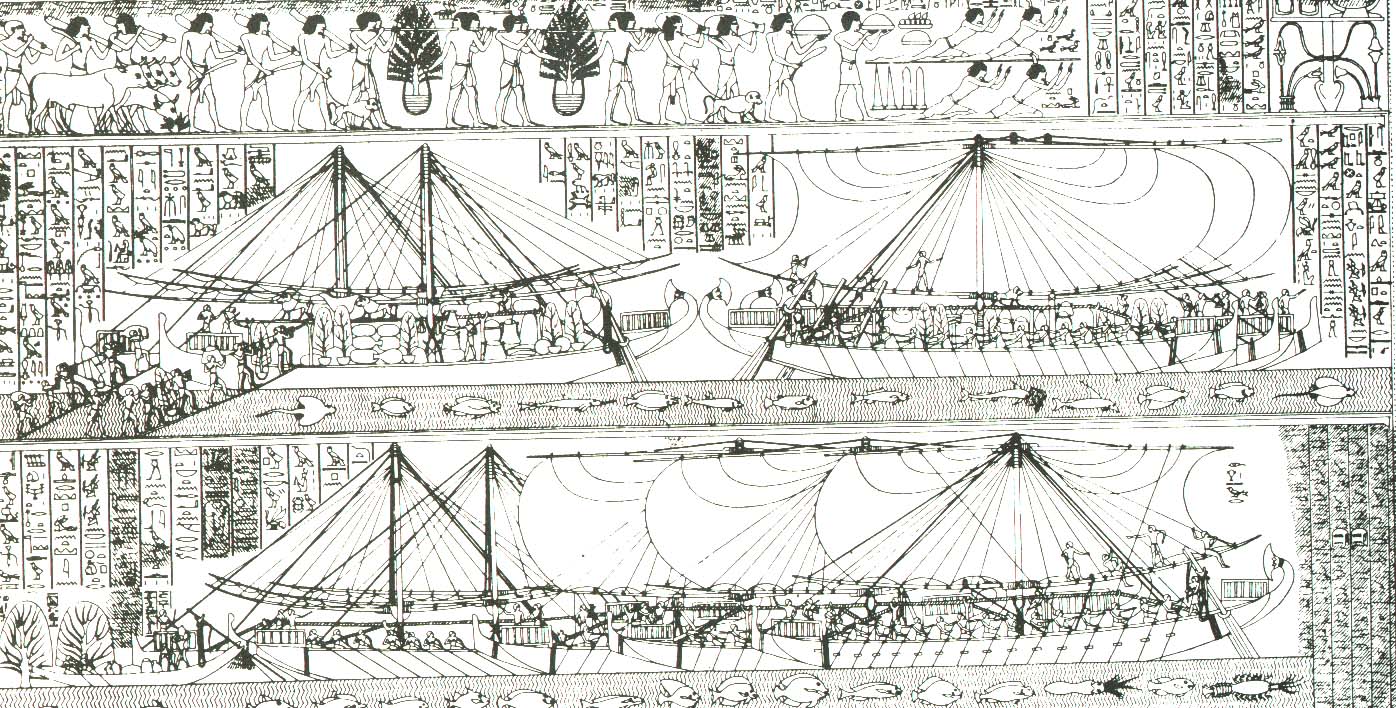 You should be looking at stuff about Punt. Incredibly, Punt has never been found--it's a lost civilization that we know only from ancient Egyptian references. That top picture shows an Egyptian naval expedition to the land of Punt sponsored by the Egyptian Pharaoh/Queen Hatshepsut (from the 18th Dynasty, in case you're curious)--but where the hell was it? What did it look like? What were the inhabitants like? Mysteries! What fun!
Originally posted October 5, 2007.
Subscribe to:
Posts (Atom)