Strangely enough, I am slightly ahead of the curve in terms of this semester's work. Turns out it's much easier to get cracking earlier in the semester when one isn't working three days a week, doesn't have to write a lecture about STDs and health service art from scratch [ha! bad pun], and --instead of 3 seminars with 100 pages of reading and a 3 page response paper PER CLASS PER WEEK-- takes only 2 classes. In fact, the first two weeks of January were so profoundly hellish, it was actually a relief to head into February. Weird.
As a result, I'm hoping to be able to blog just a little bit more (including on Kittenheads). Considering the bad luck I've had with blogging of a personal nature, I'm going to have to come up with a more specific objective, so I'll probably just post more about the artsy stuff I'm finding.
Like, for example, Holland Cotter's gleeful celebration of the tanking of the art market at NYTimes, The Boom Is Over. Long Live the Art! Laugh it up, buster. We'll see how many art critics are left in a year.
In the meantime, I will leave you with the following quote describing the plight of the foreign worker in spiraling Dubai:
"We are all just sleeping, smoking, drinking coffee and having headaches because of the situation."*
It is rather strange and sad that this is a pretty accurate description of my life in general--with or without any economic crises.
*From from Hamza Thiab, a 27-year-old Iraqi who moved to Dubai from Baghdad in 2005, lost his job, and has until the end of February to find a new one. In Laid-Off Foreigners Flee as Dubai Spirals Down. (NYTimes,Feb 11, 2009)
For those of us nerdbombs out there that actually enjoy this sort of stuff--Blythe, I'm talking to you--here are two fabulous things, both related to my favorite dictionary website, AskOxford.com (what, you don't have a favorite dictionary website?):
1. Their FAQ is the awesomest thing I've come across in at least a week and a half (slow week). Sample question and answer:
There is a word 'erotology' which is defined as "the 'science' of love". This is a rarely used word, except in anthropology, where it is found slightly more often. This term really relates to the study of sexual activity and techniques rather than to the study of love itself.* The only word this editor can think of for that is 'marriage'!**
2. They have also posted a fairly comprehensive list of terms of venery*... by which, of course, I mean collective terms for animals. Some of my favorites include: cats: clowder owls: parliament rattlesnakes: rhumba ferrets: business ...and this one wins for just sheer, wonderful absurdity:
Illustration--and interesting etymological background--may be found at Le Pen Quotidien.
I saw The Lives of Others last year and it's so incredibly great that I can't even begin to explain. It's a caper! And a spy movie! And the music is great! And the acting is phenomenal! And my German teacher knew the lead actor!*
If you haven't seen it, RENT IT--it's fabulous. Even the music gives me a frission. Don't ask me why Berlin holds such a fascination for me (well, the answer is pretty simply that I lived there for 3 months working as a walking tour guide), but I've read a pretty significant number of books on Berlin/German history (I consider myself somewhat better acquainted with Berlin & German history than the average person yet somewhat far from a scholar; the books I have listed at the end fo the post after the jump).
...So when I say that I already knew the plot for Valkyrie, that Stauffenberg (that's Lt. Col. Klaus Philip Schenk, Count von Stauffenberg to the history books) is somewhat of a national hero in modern Germany, and that the idea of Tom Cruise with his Chicket-gum teeth swanning about with his ridiculous American accent and Disneyfied script makes me want to VOMIT, then perhaps you can understand why. Whenever Tom Cruise speaks I find myself torn between laughing and crying (the words in italics are to be read with a slit-eyed INTENSE WHISPER): At 0:16: "By nightfall I want to know that Hitler's Germany has seen its last sunrise." At 1:31: "Anything... is a very... dangerous word." At 2:45: "Action... is inevitable... as are the consequences." ....................ARGGGH. Shoot me.
...I mean, given my Berlin obsession, I'm going to have to see it eventually, but URGH.
* You know, some of the other movies I feel as strongly about as The Lives of Others include Hot Fuzz, Ocean's Eleven, and Sneakers. Go figure.
Berlinobibliophilia after the jump-- I have read the following books on Berlin/Germany Stasiland by Anna Funder
Berlin: A Novelby Pierre Frei and Anthea Bell** (this was not actually a very good book)
The point is: I'VE READ A LOT ABOUT BERLIN. TOM CRUISE AND BRYAN SINGER AND THEIR WEIRDO HOLLYWOOD AMERICAN CHEESEBURGERS CAN SUCK IT.
** These books were all vacation books. As in, I read them on the beach instead of novels. Possibly the best non-beach beach book -- The Zanzibar Chest by Aidan Hartley, which still counts among the most important books I think I've ever read -- I read while on the blissful sands of Zanzibar. There was nothing to put my days flopping around drinking beer and agonizing over a death-spiral relationship in perspective like recollections of Ethiopia, Somalia, and Rwanda in the 80s and 90s.
I have returned safely from the wilds of South Cakalacky, where many notable presents were exchanged, my favorite being the massage I got from my sis-in-law. Finished the paper on masquerade topoi in romance novels (which I'll send to you if you ask really nicely), met the world's most wonderful dog, and
I am alone, in my apartment with two cats, Indian food, and a sinus infection, writing a paper that was supposed to be due on December 18th. Have a happy effing new year, people.*
*Not that this prevented me from going out to a wine bar last night with former gallery boss and allowing a food stylist to arrange confetti in my hair all night. I live a weird life.
Oh my god. After I emailed the professor [of my class on African masquerade (subtitled: "Rhetoric, Theory, Practice")] a few sections from books I'd read recently, she suggested and approved a research topic on the trope of masks/ masquerade/ masking in contemporary romance fiction. She thinks it might be publishable. You know what this means, right? I’m going to read romance novels FOR A RESEARCH PAPER. OH MY GOD OHMYGOD OHMYGOD. I almost just jumped around the campus screaming with glee. Seriously.
Philippe Halsman, Dalì Atomicus, (1948) I connect more with Dalì in this photo than with the cats.
Yes, I'm an art historian. No, as yet there's not a whole lot ofany art involved in the paper. No, I haven't really studied literature since my Shakespeare class eight years ago. So, you know ...if any of you actual literature scholars have any thoughts or suggestions on the topic--i.e., masks as a theme, pulp fiction as a research topic--I would be forever grateful. Rex, I'm looking at you, sir.
Woohoo!
The paper proposal itself--along with more happy jumping--after the break...
PROPOSAL: For a genre as widely popular as mass-market paperback romance novels, there is much that lies unexplored and, therefore, unproblematized in scholarly discourse.[1] I propose to write about the role of masks/masking (and potentially masquerade) in [primarily] 20th and 21st century romance novels. Has masking as theme and plot device remained stable within the literature? How has it changed? Who is masked and why? What do they mask? What are the gender politics involved? How are masks and the act of masking structured in these writings? I anticipate that the story of Cinderella as an archetype will be a pivotal part of my inquiry; I may briefly explore masks and masking in fairy tales. The Regency era, being frequently depicted in such literature, will likely provide the bulk of primary source reading material.
For example, Julia Quinn’s novel, Romancing Mister Bridgerton, with its heroine who feels more "herself" at a masquerade—and who secretly writes a society column under a pen name—uses masks, masking, and masquerade as both explicit and implicit themes. Another example is that of Gaelen Foley’s Lord of Fire, in which a grotesque, carnivalesque masquerade is a scene of revulsion, arousal, and revelation; that this event occurs in the house of a spy, whose profession he conceals from everyone (except, in the end, his beloved), is only fitting. Eloisa James’s Duchess at Nightwill serve as [this proposal's] final example: the heroine spends a large portion of the book in drag as a male. Using these and other examples, I plan to explore different uses of and reactions to masks both literal and metaphorical, masking as an act of concealment, disguise, or liberation, and masquerade as setpiece and long-standing leitmotif.
The proliferation of masking themes extends beyond the sphere of plot and even beyond that of the book itself. The covers of mass market paperbacks often consist of a titillating scene of seduction, peril, or high drama concealed behind the title on the cover. The act of purchasing and reading these books is often fodder for derision on the part of serious-minded folk—with concomitant shame on the part of the reader. In response, many readers of such works of fiction hide or deny reading them—indeed, they are often said to mask their enjoyment. A corollary is the double life that an author of such books sometimes chooses to lead: a high-profile example is that of Mary Bly, a Fordham professor who pens novels under the name Eloisa James.
I am also trying to feel out what sort of links there may be with Bakhtin's conception of carnival (if any)—both are escapist forms of popular entertainment underpinned and dependent upon levels of fantasy and inversion of "everyday life" (where the heroine always gets her hero, and the hero is always worth getting). (There are significant and enormous differences, of course; I am not going to claim that they are the same thing. ...On the other hand, carnival is only one type of expression of utopian fantasy—perhaps, as Nancy Scheper-Hughes suggests, a particularly male one[2]—while a more introverted activity (like reading) functions as both ideal for and idealized by a still-disenfranchised and often sexually exploited population.)
[1]They are read by millions—a glance at the New York Times bestseller list almost invariably shows a romance novel among the other escapist fare listed. Indeed, the Romance Writers of America data show that in the past five years the percentage of male readers of romances has shot up to 22 percent, "a shift that surely warrants someone's critical attention." Selinger, Eric Murphy. "Rereading the Romance," Contemporary Literature XLVIII, 2 (2007), p. 320. [2] In Nancy Scheper-Hughes, "Carnaval," Death Without Weeping: the Violence of Everyday Life in Brazil (Berkeley: University of California Press, 1992), pp. 480-504, 555.
And now, because I've just got to put this photo in, variants of Dalì Atomicus: According to Wikipedia, repository of all known knowledge and supposition, it took 28 attempts before both Dali and Halsman were satisfied with the result.
In searching for Georgette Heyer eBooks to download (for a paper on masks and masking in popular romance fiction), I ran across the eHarlequin.com bestseller list. Witness:
I cannot stop laughing. I especially enjoy the question mark on #8, as well as the fact that Italians are the lovers of choice. I think if you combined it all into one, you'd get an arranged marriage to a Mediterranean billionaire prince who, having never seen his betrothed before, mistakes her for a courtesan and abducts her--on Christmas! After he [ruthlessly!] beds and impregnates her, this captive [former] virgin runs--waywardly--away to the Upper East Side? [Then they live happily ever after, etc etc etc ad nauseam.] Really, just how many adjectives do you need for one title? Especially when the cover pretty much says it all (i.e., SEX).
palimpsest |pælm(p)sst| noun A parchment or other writing surface on which the original text has been effaced or partially erased, and then overwritten by another; a manuscript in which later writing has been superimposed on earlier (effaced) writing. · In extended use: a thing likened to such a writing surface, esp. in having been reused or altered while still retaining traces of its earlier form; a multilayered record: [Cy Twombly's art] is a perverse sort of palimpsest.*
Cy Twombly (American, 1928-), The Italians, 1961, oil, pencil, and crayon on canvas, 6 feet 6 5/8 inches x 8 feet 6 1/4 inches (199.5 x 259.6 cm), Museum of Modern Art, NY.
*Roland Barthes, "Non Multa Sed Multum," (1976) in Nicola del Roscio ed., Writings on Twombly (Schmirmer/Mosel 2002), p. 94.
I'm not entirely sure if I actively dislike Robert Rauschenberg's work or not because I can't get past phrases like, "...the transformation of the de Kooning into what Rauschenberg called a 'monochrome no-image' can be understood from a Bergonsonian perspective as the evacuation of intentional imagery and individual expression (i.e., 'art') in favor of a receptivity to contingent visual sensations (i.e., 'life')."*
Ow.
Video that helps explain the above drawing:
In other news, I'm in love with this song. *from Brandon Joseph, "White on White," in Random Order: Robert Rasuchenberg and the Neo-Avantgarde (MIT, 2007), p. 63.
I bring you an antidote for the perniciously catchy "Jesus is my Friend" (my original post below): silly rude boys. Many thanks, yet again, to Rex Parker. Were it not for his quick thinking, I'd still be caught in a chirpy 1970s vortex.
Another surefire way of ridding yourself of the desire to skank for Jesus is the following equally catchy submission from Devendra Banhart (and yes, that is Natalie Portman):
Now I just want to Bollywood dance for Shiva. My most extreme gratitude goes to Blythe for bringing this video in all its absurd glory to my attention.
And to whoever it was that emailed my post to his/her friends—thus increasing my blog hits sixfold (not hard when you get 5 hits a day)—a hearty thank you.
On a side note, for those dorks like me who are curious about the whole "Sonseed" phenomenon, Dougspoiltation originally broke the story—and he actually interviewed Sal, the lead singer. All I have to say is: Wow.
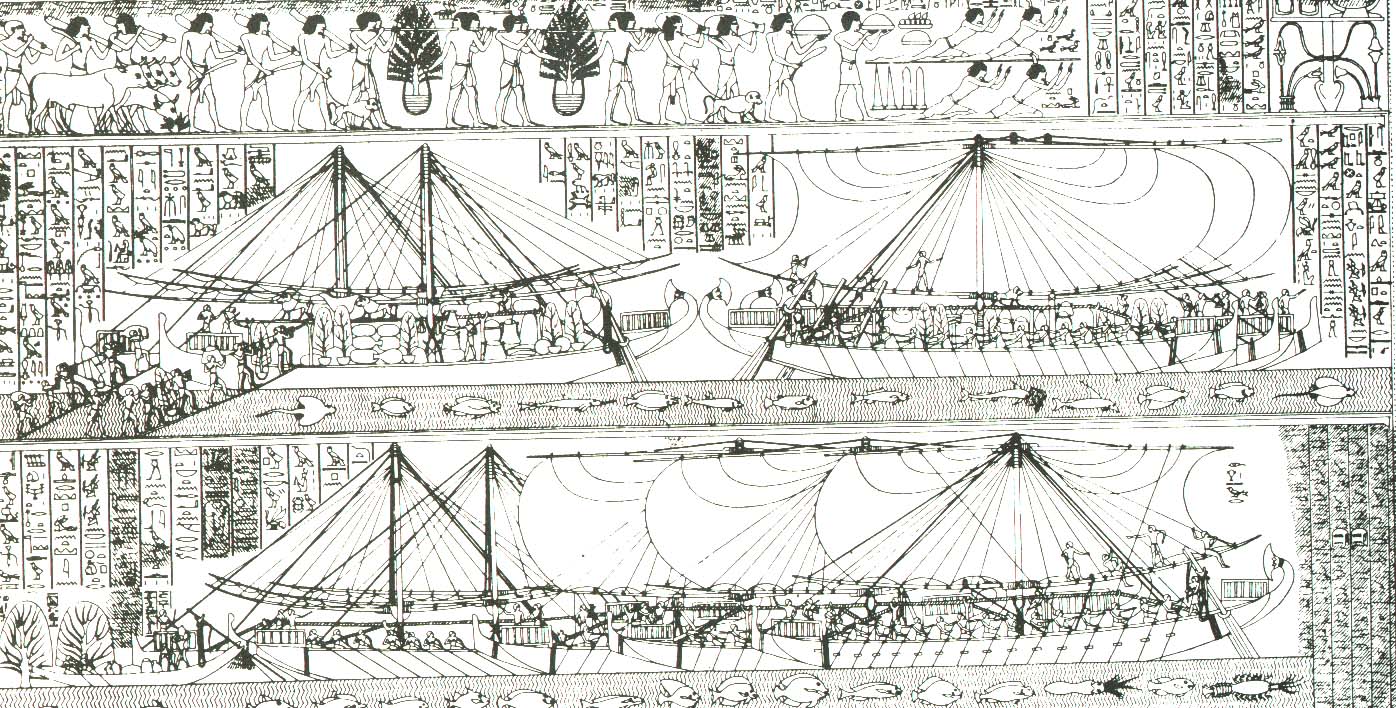
You should be looking at stuff about Punt. Incredibly, Punt has never been found--it's a lost civilization that we know only from ancient Egyptian references. That top picture shows an Egyptian naval expedition to the land of Punt sponsored by the Egyptian Pharaoh/Queen Hatshepsut (from the 18th Dynasty, in case you're curious)--but where the hell was it? What did it look like? What were the inhabitants like? Mysteries! What fun!


 pæl
pæl m
m s
s st
st