Showing posts with label artsy stuff. Show all posts

Friday, June 12, 2009

gyro?


I think I may be drunk.* In Florence, bitches. (I just wrote "in Florence, itches," which may refer to my very first cold sore** breakout in Rome after 30 years of no cold sores and 6 months of celibacy. Which sucks, let me tell you. I mean, if I get cold sores then I should at least have done something ENJOYABLE to deserve them, right? None of this "I have no idea where they came from" crap. Because I am hideously vain, I retouched EVERY single picture of myself from Rome. Crusty face wounds are not so attractive.)

Otherwise, Florence is great. I've climbed up to the VERY TOP of the Palazzo Vecchio, have rambled around the restricted vaults of the Duomo (in between the ceiling vaults and the timber roof, pictured--it's like a moonscape), trundled up the Leaning Tower of Pisa, gone to Positano on the Amalfi coast, fortuitously run into the Giro d'Italia, and visited Rome for 5 days. Amazing!


*Expansion of comment on Bee-spot.
**Yeah, face herpes.

Saturday, April 18, 2009

jam-packed

As I was taking a break from the 19th-Century art history conference today at Columbia, I heard a guitar piddling around, and it sounded kind of like one of my favorite bands. Which was weird, because why would VAMPIRE WEEKEND being playing at Columbia today, when I'm supposed to be in a darkened lecture hall from 9am until 5pm and it's 79 degrees outside? Well, turns out that it was indeed Vampire Weekend testing out the old sound system and that they were going to play at 3pm, followed by Talib Kweli. (Yes, really.)


Needless to say, I skipped out on the afternoon sessions (though I returned, of course, for the cheese and cheap wine at the reception) and stood on Alma Mater's feet to enjoy the 45 minute set and the blazing sunshine:


It was, as the French say, LE AWESOME. I mean, really, I'm just wandering around campus, happen to hear a few random notes of music and discover that one of my favorite bands is playing that day? And it's beautiful out? And the band is LE AWESOME live? This, my friends, THIS, is why I love New York City.

...And for those of you out there who aren't jealous enough, I give you a snippet of the closing number, "Walcott":


Fantastic.

Sunday, February 15, 2009

ahead of the curve?

Strangely enough, I am slightly ahead of the curve in terms of this semester's work. Turns out it's much easier to get cracking earlier in the semester when one isn't working three days a week, doesn't have to write a lecture about STDs and health service art from scratch [ha! bad pun], and --instead of 3 seminars with 100 pages of reading and a 3 page response paper PER CLASS PER WEEK-- takes only 2 classes. In fact, the first two weeks of January were so profoundly hellish, it was actually a relief to head into February. Weird.

As a result, I'm hoping to be able to blog just a little bit more (including on Kittenheads). Considering the bad luck I've had with blogging of a personal nature, I'm going to have to come up with a more specific objective, so I'll probably just post more about the artsy stuff I'm finding.

Like, for example, Holland Cotter's gleeful celebration of the tanking of the art market at NYTimes, The Boom Is Over. Long Live the Art! Laugh it up, buster. We'll see how many art critics are left in a year.

In the meantime, I will leave you with the following quote describing the plight of the foreign worker in spiraling Dubai:
"We are all just sleeping, smoking, drinking coffee and having headaches because of the situation."*
It is rather strange and sad that this is a pretty accurate description of my life in general--with or without any economic crises.


*From from Hamza Thiab, a 27-year-old Iraqi who moved to Dubai from Baghdad in 2005, lost his job, and has until the end of February to find a new one. In Laid-Off Foreigners Flee as Dubai Spirals Down. (NYTimes,Feb 11, 2009)

Thursday, February 12, 2009

Worst Laid Plans

Given our similarity in size (scrawny), features (small), attitude (snarky), and a certain overly dramatic way of telling a story, perhaps it is no coincidence that, in high school, the woman in this video and I were frequently confused for each other. She started off college as an art history major, I as a drama major, and then we switched. I kind of have a feeling that we both should have stuck to our original plans. The best laid plans...

Wednesday, January 28, 2009

Guess who's studying in Florence over the summer?


Your favorite blogger (ME), that's who. For four weeks. FUNDED (I hope). In MAY AND JUNE. Oh yeah.

The last time I was in Florence I was whizzing around on the back of a scooter driven by a soccer-mad Italian man named Domenico.

Check. It. Out.:
READING FLORENCE AND TUSCAN ARCHITECTURE AND URBANISM: AN INTRODUCTION
May 18-June 13, 2009
As an introduction to the buildings and public spaces of medieval and early Renaissance Florence, the brilliant architectural culture that between the 1290s and c. 1470 led all Europe. This course is conducted entirely on site in the buildings, streets, and squares of the city. Beyond fostering factual knowledge, we develop skills in archaeological, formal, iconographic, contextual, and site analysis. These skills potentially address not only Florentine studies, but the history of architecture in general. Emphasis is placed on the way buildings are situated, initiated, grow and change through time; the evolution of the classical tradition in Florence; the role of individual architects vs. collaborations; the materials and detailing of buildings, all media included; the form and function of public space, including perspectivism as well as religious, political, and economic use; the expansion and development of the city. Sites include the Baptistery, S. Miniato al Monte, S. Maria Novella, S. Croce, the Cathedral and Campanile, Orsanmichele, the Palazzo Vecchio, S. Lorenzo, the Pazzi Chapel, the Ospedale degli Innocenti, S. Spirito, the Palazzo Medici, and other aspects of the city, among them the walls and key vernacular works, in every case, studied in the context of their spatial environment. Access to parts of major buildings not normally open to the public is gained whenever possible. In addition, several field trips take the class outside Florence, for example to Siena, Pienza, and Montepulciano.

Words can not express how thrilled I am.

Thursday, January 1, 2009

my face: it hurts me more than it's hurting you

I have returned safely from the wilds of South Cakalacky, where many notable presents were exchanged, my favorite being the massage I got from my sis-in-law. Finished the paper on masquerade topoi in romance novels (which I'll send to you if you ask really nicely), met the world's most wonderful dog, and

I am alone, in my apartment with two cats, Indian food, and a sinus infection, writing a paper that was supposed to be due on December 18th. Have a happy effing new year, people.*


*Not that this prevented me from going out to a wine bar last night with former gallery boss and allowing a food stylist to arrange confetti in my hair all night. I live a weird life.

Monday, December 22, 2008

I blame the yellow shoes


Please see this post for an explanation of why.

My gallery went out of business--last night was the closing party--and I got bombed. Very sad, especially considering that it's just about the coolest, most laid-back, down-to-earth gallery on the planet. SO much better to go out with a bang than with a sniffly whimper.

Tuesday, October 14, 2008

jumping for joy; or, [almost] all my research dreams have come true

Oh my god. After I emailed the professor [of my class on African masquerade (subtitled: "Rhetoric, Theory, Practice")] a few sections from books I'd read recently, she suggested and approved a research topic on the trope of masks/ masquerade/ masking in contemporary romance fiction. She thinks it might be publishable. You know what this means, right? I’m going to read romance novels FOR A RESEARCH PAPER. OH MY GOD OHMYGOD OHMYGOD. I almost just jumped around the campus screaming with glee. Seriously.
Philippe Halsman, Dalì Atomicus, (1948)
I connect more with Dalì in this photo than with the cats.

Yes, I'm an art historian. No, as yet there's not a whole lot of any art involved in the paper. No, I haven't really studied literature since my Shakespeare class eight years ago. So, you know ...if any of you actual literature scholars have any thoughts or suggestions on the topic--i.e., masks as a theme, pulp fiction as a research topic--I would be forever grateful. Rex, I'm looking at you, sir.

Woohoo!
The paper proposal itself--along with more happy jumping--after the break...


PROPOSAL:
For a genre as widely popular as mass-market paperback romance novels, there is much that lies unexplored and, therefore, unproblematized in scholarly discourse.[1] I propose to write about the role of masks/masking (and potentially masquerade) in [primarily] 20th and 21st century romance novels. Has masking as theme and plot device remained stable within the literature? How has it changed? Who is masked and why? What do they mask? What are the gender politics involved? How are masks and the act of masking structured in these writings? I anticipate that the story of Cinderella as an archetype will be a pivotal part of my inquiry; I may briefly explore masks and masking in fairy tales. The Regency era, being frequently depicted in such literature, will likely provide the bulk of primary source reading material.

For example, Julia Quinn’s novel, Romancing Mister Bridgerton, with its heroine who feels more "herself" at a masquerade—and who secretly writes a society column under a pen name—uses masks, masking, and masquerade as both explicit and implicit themes. Another example is that of Gaelen Foley’s Lord of Fire, in which a grotesque, carnivalesque masquerade is a scene of revulsion, arousal, and revelation; that this event occurs in the house of a spy, whose profession he conceals from everyone (except, in the end, his beloved), is only fitting. Eloisa James’s Duchess at Nightwill serve as [this proposal's] final example: the heroine spends a large portion of the book in drag as a male. Using these and other examples, I plan to explore different uses of and reactions to masks both literal and metaphorical, masking as an act of concealment, disguise, or liberation, and masquerade as setpiece and long-standing leitmotif.

The proliferation of masking themes extends beyond the sphere of plot and even beyond that of the book itself. The covers of mass market paperbacks often consist of a titillating scene of seduction, peril, or high drama concealed behind the title on the cover. The act of purchasing and reading these books is often fodder for derision on the part of serious-minded folk—with concomitant shame on the part of the reader. In response, many readers of such works of fiction hide or deny reading them—indeed, they are often said to mask their enjoyment. A corollary is the double life that an author of such books sometimes chooses to lead: a high-profile example is that of Mary Bly, a Fordham professor who pens novels under the name Eloisa James.

I am also trying to feel out what sort of links there may be with Bakhtin's conception of carnival (if any)—both are escapist forms of popular entertainment underpinned and dependent upon levels of fantasy and inversion of "everyday life" (where the heroine always gets her hero, and the hero is always worth getting). (There are significant and enormous differences, of course; I am not going to claim that they are the same thing. ...On the other hand, carnival is only one type of expression of utopian fantasy—perhaps, as Nancy Scheper-Hughes suggests, a particularly male one[2]—while a more introverted activity (like reading) functions as both ideal for and idealized by a still-disenfranchised and often sexually exploited population.)

[1]They are read by millions—a glance at the New York Times bestseller list almost invariably shows a romance novel among the other escapist fare listed. Indeed, the Romance Writers of America data show that in the past five years the percentage of male readers of romances has shot up to 22 percent, "a shift that surely warrants someone's critical attention." Selinger, Eric Murphy. "Rereading the Romance," Contemporary Literature XLVIII, 2 (2007), p. 320.
[2] In Nancy Scheper-Hughes, "Carnaval," Death Without Weeping: the Violence of Everyday Life in Brazil (Berkeley: University of California Press, 1992), pp. 480-504, 555.


And now, because I've just got to put this photo in, variants of Dalì Atomicus:
According to Wikipedia, repository of all known knowledge and supposition, it took 28 attempts before both Dali and Halsman were satisfied with the result.

Thursday, September 25, 2008

Robert Rauschenberg makes my brain hurt

Robert Rauschenberg, Erased de Kooning Drawing, 1953; traces of ink and crayon; Collection SFMOMA, purchased through a gift of Phyllis Wattis; © Robert Rauschenberg / Licensed by VAGA, New York


I'm not entirely sure if I actively dislike Robert Rauschenberg's work or not because I can't get past phrases like, "...the transformation of the de Kooning into what Rauschenberg called a 'monochrome no-image' can be understood from a Bergonsonian perspective as the evacuation of intentional imagery and individual expression (i.e., 'art') in favor of a receptivity to contingent visual sensations (i.e., 'life')."*

Ow.

Video that helps explain the above drawing:


In other news, I'm in love with this song.

*from Brandon Joseph, "White on White," in Random Order: Robert Rasuchenberg and the Neo-Avantgarde (MIT, 2007), p. 63.

Louise Bourgeois at the Guggenheim

WARNING! Long-winded exhibition review dead ahead...

At the Louise Bourgeois retrospective at the Solomon R. Guggenheim Collection, we are greeted at the entrance by a large metal spider and what look to be two victims suspended in shiny bright cocoons from above. As Nancy Spector, the curator of the exhibition and the Guggenheim’s chief curator, acknowledges in the introductory text, the spiral of Frank Lloyd Wright’s Guggenheim at 88th Street is a uniquely fitting venue in which to present a retrospective of this ever-avant-garde artist who has returned to themes and motifs throughout her career. Bourgeois’ work functions in a world of unstable, opposing binaries: open/closed, young/old, gravity/attenuation, benign/threatening, human/building, soft/hard, spiral/linear. Works cluster along the walls in chronological groupings; the architectural scale (and color) of the winding path at the Guggenheim lends itself felicitously to the presentation of these objects, and the narrowness of the presentation space focuses the attention by permitting only a few works in the viewer’s field of vision at any one time. Though the spiral ramp forces a linear narrative, its great benefit is its ability to disrupt this strict chronology: by merely peering across the vertigo-inducing open center, the visitor sees works that came before and glimpses of what will follow. In fact, it is largely by virtue of Lloyd Wright’s whorl of an exhibition space that the show coheres—one might almost hope that all retrospectives be shown here, for nowhere else is there the ability to experience both a linear (that is to say, chronological) progression as well as a cross-section of an artist’s oeuvre.

After the opening salvo of the spider and a brief introduction to her paintings, we are launched into Bourgeois’ career in 1940s New York while married to art historian Robert Goldwater—a more propitious time and place (and husband) is hard to imagine. It was during this time in the late 1940s and early 50s that Bourgeois created the sculptural series known as “Personages,” (left) whose totemesque, vaguely anthropomorphic wood and metal forms, notably “Portrait of C.V.” (1947-49; wood, paint, metal wire), “Persistent Antagonism” (1946-48; wood, paint, metal wire), “The Winged Figure” (1948; wood, paint, nails), and “Sleeping Figure” (1950, bronze), have their relatives in the sculptural art of central equatorial Africa (as the exhibition “Eternal Ancestors: Art of the Central African Reliquary” at the Metropolitan Museum so effectively demonstrated last winter). The slightly later wooden stacked sculptures, whose attenuation recalls Giacommetti’s emaciated figures, often present an escarpment near or at the top, frustrating the ascension to the topmost level and recalling Bourgeois’ quote that “Skyscrapers reflect the human condition. They do not touch.”

After a decade of absence, Bourgeois emerged in the 1960s to create an odd topsy-turvy world where phallic buds derive from clouds and breasts emerge from the earth to become “cumuls.” Extraordinarily adept at segmenting and de-humanizing the human body, she others it, rendering it insectlike and, by so doing, reinforcing its messy actuality and the earthy humor of human existence. Biomorphic forms (like “Lair,” 1962), which occupy one section look nothing so much as sculpted excremental blobs, have something of the honeycomb—or, in the case of “Fee Couturiere” (1963), the wasps’ nest—about them. Who—or what—lives in these funny little dwellings? What is hidden inside?

Though the uncircumcised penile tips—or are they preternaturally perky breast buds? Or are they fingertips?—poking their heads hopefully through drapery in “Cumul I” (1969; above) is enough to horrify one’s conservative relatives (one dare not say grandmother in this context), Bourgeois has a mastery of texture and form that renders these things all rather beautiful. Beautiful in the way that earthworms, or giving birth, or the relief of a long-awaited bodily function is beautiful. Or, in the case of “Sleeper” (1967; left)—a “cumul” wrapped protectively in a turtleneck and sitting atop two rough wooden timbers—the way a pig in a blanket carved out of marble is beautiful.

Beginning in the 1980s, Bourgeois became more willing to incorporate explicitly representational and figural elements into her work, referring more explicitly than before to memory. It was during this time that she began producing “Cells.” As individual installations in their own rights, what the “Cells” lose in efficiency they gain in narrative force. Dealing with surveillance, confinement, memory, and the interrelationships between physical and psychological pain, the range of sizes and media of these installations allowed Bourgeois to incorporate (and in some cases revisit) motifs and materials from different phases of her career. The often spiral configurations of doors that encircle the central spaces of many of the cells act as walls: as she does with that of glass windows, which are often so dirty as to preclude gazing through them to the luminous sculptural elements within, Bourgeois has perverted their natural function.

“Cell IV,” whose doors enclose a very finely carved pink marble ear across from a wood block with a large clock-like disk leaning against the wall, evokes a psychiatrist’s office, inviting the viewer to lean into the scene and whisper her secrets to the aural vessel. One of the largest and most sinister pieces in the retrospective, “Cell (Choisy)” (1990-93), encloses a marble scale model of the artist’s childhood home in a cage with dirty windows; a guillotine is poised above the only entry to the structure. Embedded in the structure of this cage and other cells, mirrors fracture the scene inside, imposing fractured, partial views on the visitor.

The soft sculptures, at the end of an arduous climb to the topmost level of the Guggenheim, have something of the taxidermy form to them. Not only are textile heads and bodies on display (as though hunting trophies, scientific specimens, or cadavers ready for autopsy), but certain stacked wood sculptures are reincarnated in quilted fabric blocks. The patchwork nature of the soft sculpture is an effective proxy for the nature of memory and the rediscovery of earlier forms and themes. The familiar textures of cloth, coupled with the explicit representations of human bodies, renders these sculptures perhaps the most viscerally disturbing pieces in the show. “Three Horizontals” (1998; fabric and steel), shows three pinkly patchworked figures coming apart at the seams and prepared for dissection on metal slabs. As they contract in size, their recognizability as human forms diminishes until the final, smallest figure is nothing more than a plucked chicken carcass with vestigial arm, leg, neck, and breast buds.

To be sure, Bourgeois maintains her sense of humor throughout—witness the last work of the show, “Couple IV” (1997): two headless and footless black fabric figures, one with a 19th century-era prosthetic leg, fornicate in a glass box. The overstuffed squeezability of these figures, sewn out of familiar, comfortable thermal waffle knit, is disturbingly at odds with the foreignness of the prosthesis and leaves one unprepared for the waffle-fabric scrotum nestled between the figures’ legs.

One gets the sense of exhaustion at the end of the show—not from the artist, but from the curators. Though Bourgeois has been making fabric sculptures for the past decade, the selection of cloth “soft” sculpture seems much more meager than other sections (the “cells” for example). The physical properties of weight and gravity seen in the stacked sculptures are certainly emphasized by the trek up the Guggenheim rotunda—the exhausting effort of that climb becomes conflated with the works at and near the summit (one is forcibly reminded, too, of Breugel’s spiral Tower of Babel, another favorite of Bourgeois’). The late work (what is discussed in Linda Nochlin’s catalogue entry as perhaps Bourgeois’ “Old-Age style”) almost seems a sparsely populated curatorial afterthought. After becoming steadily more massive over the course of decades—those huge multivalent cells!—that Bourgeois’ objects shrink in size should not, however, be seen as a diminishment of her capabilities.

One gets the sense, too, that Bourgeois arrived fully formed as an artist—there are very few fits and starts and no failures in evidence at this show, and there is a lack of artistic context that leaves this visitor dissatisfied. On a different note, the well-written and judiciously placed wall labels perform their function admirably—explanatory text for selected items whets the reader’s appetite (and wallet) for the oddly organized yet informative exhibition catalogue (though, styled as a glossary, good luck trying to find anything in it).

Overall, in surveying Bourgeois’ mastery of many different media, styles of presentation, and artistic reinvention, one must appreciate her chameleon-like nature, the best parallel for which is most certainly Madonna (or should we instead be saying that Madonna is pop culture’s Louise Bourgeois?). Though the presentation of the show, with all phases of Bourgeois’ long career represented, supports this reading, Bourgeois might as well have already cocked up her toes for all that the Guggenheim enshrines these different incarnations. Whereas the J.M.W. Turner show at the Metropolitan Museum down the street suffers from too much of a good thing, the Bourgeois show strikes this viewer as almost a little superficial; the arachnid in the center foyer notwithstanding, the absence of the spider series is a serious oversight. But perhaps, like a good actor, that is the mark of a good artist’s retrospective: leave them panting for more.

Tuesday, September 23, 2008

new header

Check out the new header! Most of the images are courtesy of Rex Parker's Pop Sensation, which also sports a header designed by yours truly. Thanks, Rex!

Saturday, September 20, 2008

no, really, what you should be looking at: Adam Stennett

Adam Stennett. Four Mice in Diagonal Pipe. 2003. Oil on linen, 36 x 36 inches

Adam Stennett. Where Are You When You Aren't Here?. 2002. Oil on linen, 36 x 36 inches


Adam Stennett. Nutmeg (Myristica fragrans). 2008. Acrylic on paper, 30 x 44 inches


I wrote about Adam Stennett almost a year ago and I still think his art is fabulous. It doesn't hurt that he's a nice guy, too.

Above we've got two older paintings, which are both square and would go very well together as pendants. In the years since these two [early] mouse paintings, he's definitely mastered his technique better (see here and here), but there's something about their hopeful little black eyes that I really enjoy. So friendly. I think my cats would really enjoy the paintings (and the vaguely industrial impressionist vibe I get from them), too... I mean, we don't call him Learned Claw for nothing, do we?

The last one is a very recent painting, which is a great combination of Dutch still-life and grisaille; I'd buy it myself, if I could. ...Well, I'd buy them all if I could, I'm not going to lie to you. I'd put the last one in my kitchen. Ha! What an excellent commentary on my cooking skills.


P.S. I'm writing about these paintings in particular because they're all still available, which fact allows me to nurture the vain dream of them living in my apartment despite my lack of cash.

Monday, September 15, 2008

the most perfect way to piss off the French

Is by placing Jeff Koons' art in Versailles.   This represents possibly the most fabulous melding of ridiculous contemporary art and exhibition space EVER.  Michael Jackson and Bubbles surrounded by rococo decor?  Perfect!  The setting endows the work with a deeper irony than it had before--and with Koons, that's saying a lot.

Saturday, September 13, 2008

what does an art history grad student do all day?

Mask with Encircling Horns
Wood and kaolin, L: 62.5 cm. H: 42 cm
Collected by Aristide Courtois, Ex-coll. Josef Müller
© Barbier-Mueller Museum, Geneva
Inv. BMG 1019-15
Photo P.-A.Ferrazzini

Well, I'll try to give you an idea. Today, after waking up and deciding what to wear, a somewhat involved process as I am one of the world's most indecisive dressers and I seem only to own uncomfortable shoes these days, I will go to [my grad school]. There I will have lunch with other students in our lovely marble lunch room before sitting in on a class on classicism/anti-classicism in European art between the wars--a friend of mine is giving a presentation on Nazi architecture, and I remain interested in pretty much anything German and potentially dealing with Berlin from about 1900-present. [I lived in Berlin for a few sweet months in the spring and summer of 2004. It's a truly amazing place.]

After the presentation (during which I will hopefully NOT fall asleep), I will go to [redacted world-famous museum], where I will look at the Kwele mask they have in storage. What do I mean by "look at"? Basically, I will try to do with a physical object what literary folks do with a book: analyze the crap out of it.


Pipibudze Mask
Wood and kaolin, H: 25.4 cm
Ex-coll. Tristan Tzara
© Barbier-Mueller Museum, Geneva; Inv. BMG 1019-80
Photo P.-A.Ferrazzini

What does the mask look like in person? How are the paints applied? What does the object tell me about the people who made it? How does it inform what I already know about the type of object it is? Does it fit neatly into the corpus, or is it a problematic inclusion? More importantly, what does it look like?


Gong Mask
Wood and pigment, H: 55 cm
© Musée Dapper, Paris.
Photo M.Carrieri

What can we say about the masks I've posted here? Well, they all exhibit bi-lateral symmetry and polychromy. Several of the masks have protruding elements like horns (on the first and last masks), teeth (on the gorilla, third), or trunks (on the elephant, fourth); despite this, they generally remain two-dimensional--what does it mean that this is not exactly true for the elephant? There is a strong preference for heart-shaped faces--are there similarities to other masking traditions in the area? I'll probably spend a few hours trying to find the answer to this question--and it's this sort of inquiry, my friends, that keeps me in the library until the long hours of the night.

It's not that art historians simply look at an object and then write about it, no no no: you have to figure out WHY it looks like it does. This is always a crazy big question, because it means that you have to think about what else looks like your object, why does that other thing look like that... How do all aspects of your object inform what it looks like--and how does what it looks like inform what you know about the artist, the patron, the society, the religion, the artistic practice in the region, etc. etc. ad nauseam. And then you have to go back and look at the object again before you forget what it looks like. It's like a great big three-dimensional web in a dark room, and you've got a dinky little flashlight.


Mask with Trunk (Elephant)
Wood and pigment, H: 76.2 cm
The Metropolitan Museum of Art, The Michael C.Rockefeller Memorial Collection,
Gift of Nelson A.Rockefeller, New York, 1964. 1978.412.292
© 1989 The Metropolitan Museum of Art

Anyway, these masks are quite striking, aren't they? Seeing them in person is so great--but then, art is always better in person.

After looking at the mask and taking as many notes as I can about as many different aspects of it as I can, I'll spend a few hours at the museum's library, taking yet more notes on a PhD dissertation about the BaKwele ("Ba" = people). [This is why I developed tendonitis in my thumb, people. It sucks.] Then I'll go home and prepare to tutor SAT tomorrow. Excellent!


Antelope Mask
Wood and kaolin, H: 38cm
© Barbier-Mueller Museum, Geneva.Inv. BMG 1019-49.
Photo P.-A.Ferrazzini

An important note: the masks I've posted here represent a selection of all the Kwele masks out there, not that there are a lot. I tend to prefer the ones with protruding elements and high contrast values, so those are the ones that I've chosen to post on my blog--but they are NOT really that representative of the corpus of Kwele masks. For that--or if you're just interested in the masks I've posted--you should look at Louis Perrois's article on Kwele masks at Tribal Arts, "Art of the Kwele of Equatorial Africa: Ancestor masks, bush spirit masks." It's where I got the images for this post.

A caveat about the article: though Perrois is a well-respected scholar of other African art forms, he has not done very well on incorporating accurate ethnographic information into his formal analysis of these masks. Though his article is not very scholarly and rather informal, it does, however, provide a much more rounded selection of images than this blog post does.


Originally posted April 23, 2008.

up a creek with half a paddle

I have an enormous art crush on John Singer Sargent and don't particularly like Renoir (who, unfortunately, is the subject of my seminar). So I've got to connect them somehow; I'm thinking through Orientalism and exoticism (studio orientalism and the aesthetics of transformation? The fantasy of the [exotic] woman in nature?), and the trick is going to be figuring out a way to connect the images below (and about 50 other images). Presentation is on Tuesday, have written about one-third of a page. Situation dire. Eek.

Renoir, (1872) Parisian Women Dressed as Algerians

Renoir, (1870) Odalisque-Woman of Algiers
Sargent, (1907) Dolce Far Niente (It is Sweet Doing Nothing)

Sargent, (too tired to look up the date) Egyptian Girl

Courbet, (1856-7) Young Ladies on the Banks of the Seine in Summer

Nude woman (photograph after Ingres) [comment: rrrrow!]

Sargent, (1880) Fumee d'Ambergris

I suppose I can just throw a lot of Sargent pictures up and wax rhapsodic. Mmmm.

Stay tuned for next week when we explore the incredibly poorly-researched and documented BaKwele masks of equatorial Africa!

In other exciting news: QPs have been approved by first readers. I have only to receive approval from the second readers by May 7th and I'll have my masters. Sweet.

Originally posted April 20, 2008.

Friday, September 12, 2008

I am art historian, hear me roar

After about a full week of working for about 12 hours a day on it (and during my Spring Break, no less), I turned the first of my two qualifying papers in yesterday. Thank goodness.


P.S. Tigers are pretty darn cute. Especially this one:Seriously, that is the cutest picture of a tiger EVER.

Originally posted March 26, 2008.

what you should be looking at: Barnaby Barford

Barnaby Barford.

I was reading about him in Departures Magazine two and a half weeks ago and couldn't remember his name. It's been driving me bonkers because I loved what I saw, but Departures is one of those snooty weirdo AmEx things that you have to have a card to get, so I couldn't even look at the tables of contents and have just been typing in random permutations of "ironic humorous ceramic porcelain figurines art london" give or take a few words. Anyway.

Barford's stuff is very, very funny and I am slightly obsessed. As someone with a well-documented fondness for Monty Python and Steve Martin, the absurdity in both the construction and the titles just makes me melt. Witness:

Nobody fucking move.Table, Year: 2006. Dimensions: H 75 cm x L 50 cm x W 50 cm. Porcelain, Earthenware, Painted wood.

Plan for World Domination No.116. Pair of Tables, Year: 2006. Dimensions: H 70 cm x L 50 cm x W 50 cm. Porcelain, Earthenware, Resin, Glass, White Gold Leaf, Painted wood.


Struggling will only make it worse. Chandelier, Year: 2006. Dimensions: H 100 cm x L 75 cm x W 75 cm. Porcelain, Earthenware.

You sexy bitch. Mirror, Year: 2006. Dimensions: H 65 cm x W 60 cm x L 15 cm. Porcelain, Resin, GRP, Convex Mirror.

I just had to post this many items because I find them all so funny. Can't you just picture You sexy bitch right next to the door of someone's powder room? Awesome.

Originally posted October 17, 2007

Thursday, September 11, 2008

what you should be looking at: emerging artist edition

Originally posted October 12, 2007.

After rain date after rain date, I finally got to meet up with a friend. Sadly, our rain date was actually on a date when it was raining. A lot.

We began the evening by going to a gallery opening at a gallery downtown, where a classmate of mine works. The show is of Adam Stennett's work, which I saw for the first time last night and which I thought was very interesting. Stennett's paintings (no, they're not photographs he's traced or anything) remind me of Corot for some very odd reason--in the painting in this post ("Drink") there's something about the handling of the paint around her face. And don't you just love that the color of her eyes matches the color of the label? To give you yet another reason to dig this painting, consider that the title of the show is "Use Only As Directed" and it shows people doing exactly the opposite. (Hmm. I'm thirsty.) I really, super duper adore his work.

Wednesday, September 10, 2008

what you should be looking at: Punt research edition

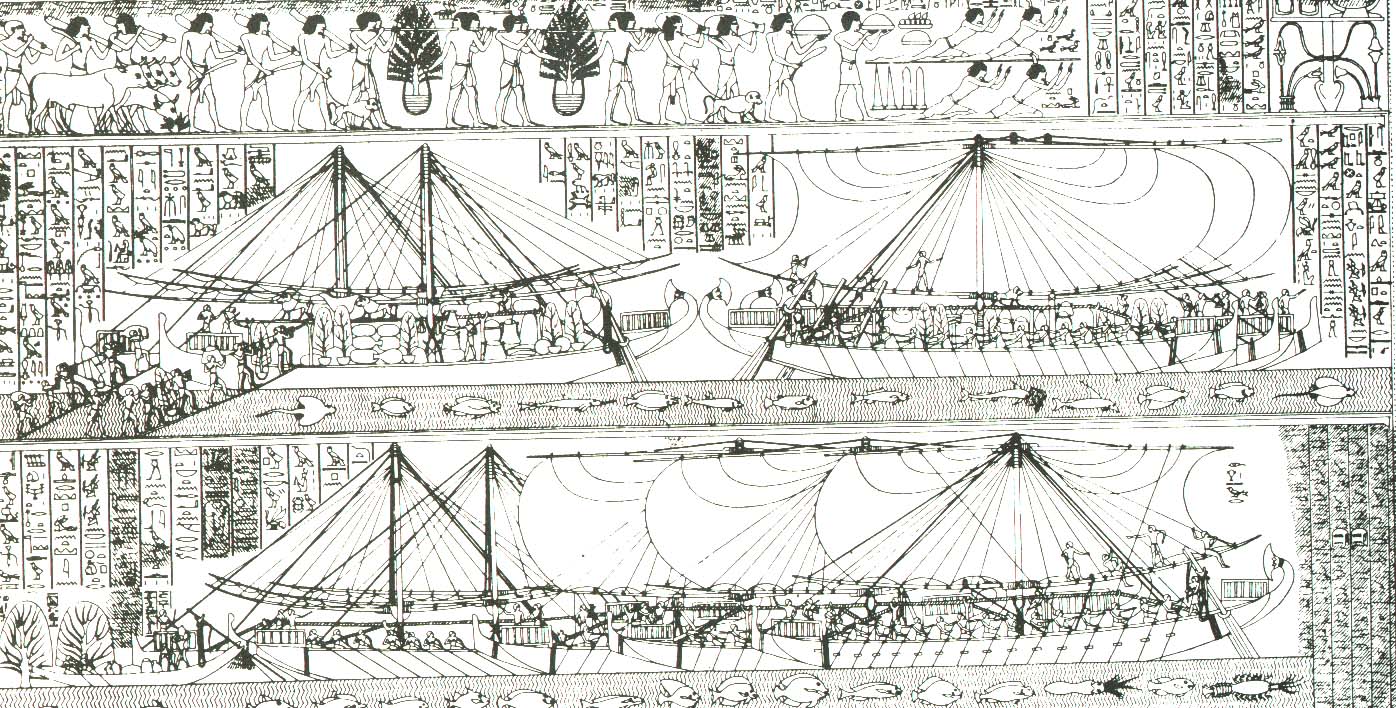
You should be looking at stuff about Punt. Incredibly, Punt has never been found--it's a lost civilization that we know only from ancient Egyptian references. That top picture shows an Egyptian naval expedition to the land of Punt sponsored by the Egyptian Pharaoh/Queen Hatshepsut (from the 18th Dynasty, in case you're curious)--but where the hell was it? What did it look like? What were the inhabitants like? Mysteries! What fun!

Originally posted October 5, 2007.

Tuesday, September 9, 2008

what you should be looking at

Originally posted September 19, 2007

You should be looking at Graciela Sacco. She's an Argentinian artist who likes to use heliography (similar to photography) on objects--soccer balls, stairs, slats of wood, books, spoons, etc. It's weird and cool and thought-provoking. I know so little about modern art--I'm at the stage where "I like what I like" and, well, let's just say that I think a lot of modern art is pretentious p***--that I'm always surprised when I like something done in the last fifty years. Take these spoons, for instance, with their hungry little sepia-colored mouths. I imagine using one to eat some soup and being a bit worried that the mouth would try to bite me. (Because, you know, inanimate objects with human attributes come to life pretty frequently. Which reminds me that when I was small I used to be scared that toilets would gobble me up--as though I'd just be sitting there, minding my own business, when --chomp! ...I have an active imagination.)

On an entirely different note, it's Talk Like A Pirate Day! Argg!


Note: The original comments were:

5 nuggets of wisdom:

Michael5000 said...
Oooh, you're right. I SHOULD be looking at Graciela Sacco. Nice.

Yar!
G said...
Ahoy!

She's pretty awesome, isn't she? I had an art crush on her for a few years now. There are a lot of really interesting Latin American contemporary artists--check out Diana Lowenstein Fine Arts, which has a host of them. Lowenstein's a dealer in Miami (where, unsurprisingly, a lot of great Latin American artists make their North American home).
stew said...
"art crush" ha

hey thanks for your very nice comment. it's so difficult to know what to hope for in this situation, so I'm keeping focused on the kid: may the kid have the best outcome possible. that's my mantra.

sucks to know someone else had this happen. urggghh.
blythe said...
i have a spoon mobile in my room. am i an artist yet?
G said...
I'm pretty sure possession of spoons means you're an artist, Blythe.